A new driveway
New construction, or a lot where the driveway never got finished. Nothing has to come out, so the job starts at layout, with the heights at the garage and the street and the direction the water should leave.
 GROUNDWORKSPAVERS & TURF
Call now
(321) 586-9227
CARS EVERY DAY. BASE BUILT FOR IT.
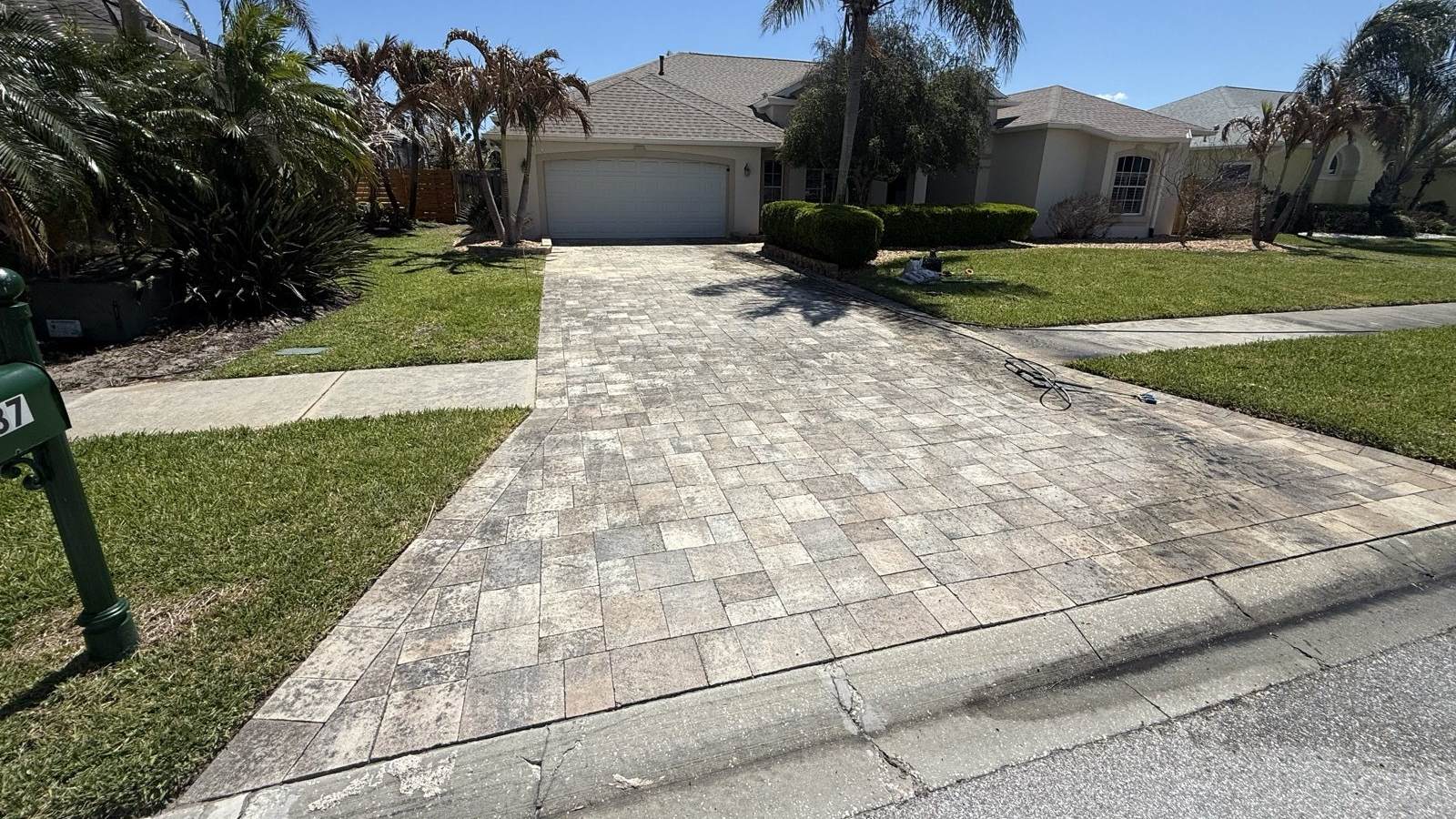
Driveway pavers for Brevard County homes, whether it's a new driveway, a tear-out of cracked concrete or old asphalt, a wider one or a parking pad. We build the base for vehicle weight first and pick the color second.
How we build it
A driveway is the hardest-working paver surface on your property. A patio holds furniture and foot traffic; a driveway holds a vehicle or two, every day, in full Brevard County sun. That changes how we build it. The compacted base under a driveway goes down thicker than it would under a patio, built in lifts and compacted layer by layer, because the load it carries isn't people. It's axle weight, turning tires, and the occasional delivery truck. From Titusville down to Palm Bay, driveway paving is base work first: the part of the job you never see is the part that decides whether the surface stays flat or starts rutting where the wheels track.
The apron, where the driveway meets the street, takes the worst of it. Tires turn hardest there, sprinkler overspray keeps it damp, and it's where a weak edge shows first, which is why our edge restraint gets anchored into the compacted base, not the sand. Estimates are free, written, and itemized. Call (321) 586-9227.
Where you're starting from
New construction, or a lot where the driveway never got finished. Nothing has to come out, so the job starts at layout, with the heights at the garage and the street and the direction the water should leave.
The old driveway gets broken up and hauled away, so none of it ends up buried under your new base. What it sat on matters too: ground that cracked a slab will do the same to a new base unless it's dealt with first.
An extra lane, a wider apron, a pad beside the garage for a boat or a third car. Anything a vehicle parks on gets a driveway base. Where new pavers butt into an existing concrete driveway, that seam needs a proper edge, because the two materials move differently.
Concrete driveway replacement
A cracked concrete driveway leaves you three options. Patch it, pour a new slab, or take it out and put pavers down instead. We install pavers, not poured concrete, so here's how the paver route goes.
Our crew breaks the old slab up and hauls it away. You don't book a separate demolition company, and none of the old concrete ends up buried under the new driveway.
Then we find out why it cracked. Concrete breaks when the ground under it moves, and new pavers on that same ground would move too. Soft or washed-out soil comes out. If roots are part of the problem, that work goes into the dig and onto your estimate as its own line.
Driveway resurfacing usually means a thin coat over the old concrete. It changes the color. It doesn't change the ground, so a crack that's still moving tends to come back through. Laying pavers over a slab that's still sound is a different question, and it's the next section on this page.
Patch or replace
One hairline crack in a slab that's otherwise flat usually isn't a reason to replace a driveway. If that's all you have, we'll tell you. Otherwise book the free walkthrough and you'll get an itemized written estimate.
Tear-out or overlay
Laying pavers over an old concrete driveway skips the demolition and the haul-off. The catch is height. An overlay raises the surface, but the garage slab and the street stay right where they are. Lift everything between them and you can end up with a lip at the garage door, an apron that no longer meets the road, or water that used to run off and now sits.
A slab cracks and sinks when the ground under it moves, from a leaking irrigation line, roots, a washout or fill nobody compacted. Pavers over the top don't fix that. They hide it for a while.
Start to finish
We walk the driveway with you, measure it, see where the water runs and check how equipment gets in. Then you get a free written estimate.
We mark the shape, set finished heights at the garage, the front walk and the street, and work out a pitch between them that sends water away from the house to a planned outlet.
On a replacement, the old concrete or asphalt gets broken out and hauled off. Then we dig to driveway depth, pull out soft spots instead of burying them, and compact the soil before any base arrives.
Base material goes in a layer at a time. Each lift is spread, raked flat and run with the plate compactor before the next one goes on.
A thin, even layer of bedding sand is screeded over the base to seat the pavers. Thick sand is a common shortcut that hides an uneven base and settles unevenly later, so low spots get fixed in the base.
Pavers go down in the pattern you picked, usually herringbone on a driveway. Wherever the pattern meets the border, a curve or the garage slab, pieces get cut to fit.
Edge restraint gets anchored into the compacted base along every open edge, at the street and along the lawn.
Joint sand gets swept in and the pavers are compacted into the bedding so the field locks together. Then we clean up and walk it with you.
Your written estimate is itemized. Our process page covers what happens from the first call to the final walkthrough.
On the job
Real footage from Groundworks paver jobs.
What that means on your job
A driveway base goes down thicker than a patio base and gets compacted in lifts, layer by layer. The load is axle weight and turning tires, not foot traffic. The base has to be built for it or the surface ruts where the wheels track.
Where the driveway meets the street, tires turn hardest and sprinkler overspray keeps the surface damp. We anchor edge restraint into the compacted base, not the sand, so the border at the street holds its line instead of creeping under daily traffic.
On a driveway we steer you to herringbone. Every paver wedges against its neighbors in two directions, so a turning tire pushes on the whole field instead of one long straight joint. Laid at 90, it runs square to the garage door. At 45 it runs on the diagonal and needs more cuts along straight edges, and a soldier course along the border gives those cuts a clean line to finish against.
Water
Brevard lots are flat, so a driveway's slope has to be built on purpose. At the walkthrough we look at where water goes now, off the roof, toward the street or into a puddle by the garage, and whether a new slope would push it next door.
Standing water on or under pavers is one of the most common reasons a paver surface fails early. If your water problem takes more than a properly pitched driveway to solve, we'll say so at the walkthrough instead of paving over it.
Permits and HOA
Driveways are the paver work most likely to need a permit, especially the apron and anything in the right-of-way. Whether yours does depends on the scope and on your city or unincorporated Brevard. We'll tell you what your job needs and who pulls the permit before you pick a start date.
HOA approval is separate, with its own packet and calendar, and a driveway can need both. Around Viera and Suntree, the committee's meeting schedule usually sets the start date, so we build the estimate around what gets approved. Bigger jobs over Florida's statutory threshold also need a Notice of Commencement recorded with the county before work begins. The full rundown is on our permits and HOA page.
Google reviews
Picked from our Google reviews and quoted word for word. Read all of them on Google.
“Groundworks came highly recommended by someone I trust and the company lived up to their strong reputation. Kelsey and the team were on time, clearly explained the whole five step paver-sealing process, and completed the job in the time frame they promised. Highly recommend!!”
Sharon G. · Google review
“Owen and his crew did a great job with our artificial turf installation, from beginning to end. The crew were all very and respectful, and cleaned up and organize their equipment out of the way each day. Yard looks great.”
Ralph E. · Google review
“Reached out to Kelsey in a panic…he was very helpful and was able to look at our situation and continue to help from the first conversation. His prompt & professional service was very appreciated. No mess left behind and our pavers look terrific.”
Julie H. · Google review
Drag or swipe to browse
Free estimate
We'll measure, look at where the water goes, and leave you an itemized written estimate, anywhere in Brevard County. No charge, no pressure.
Materials
Paver lines differ in thickness, finish and load rating. On a driveway, thickness and load rating matter more than the finish, so ask which line any estimate is quoting, ours included.
Natural stone, cooler underfoot, with color that's the stone itself. It's softer and costs more, so for a daily driver concrete pavers usually fit better. See travertine pavers.
Pavers or concrete
We install pavers, not poured concrete, so weigh this with that in mind.
The full comparison, including when plain concrete is the sensible call, is in our pavers vs. concrete guide.
Cost
Two driveways the same size can still price very differently.
Our cost guide covers each one in detail. For your own number, book the free walkthrough and get an itemized written estimate.
Built for here
Our sand holds a driveway up fine once it's compacted and boxed in. Leave an edge loose or a joint open and it starts to travel, which is what the lifts and the anchored edge restraint are for.
UV pulls color out of pavers over the years, so pick one you'll still like a shade lighter. Drips and hot tires mark any surface. A badly stained paver can be lifted out and replaced.
Heads that hit the driveway every morning keep the apron damp and work on the base, and well water leaves orange iron stains wherever it lands. Aim the heads at the grass and pick a color that hides rust.
Viera
Roughly one Viera home in five was built in 2020 or later. That's 3,874 of the 19,328 single-family homes the county tax roll counts in the Viera area (the Viera subdivisions in ZIP 32955 plus the rest of 32940 outside the Suntree subdivisions). Lots that new often sit on fresh fill. Before we write the estimate, we look at how that ground has settled and where water moves across the lot.
Architectural review comes first here, so color, pattern and layout clear the committee before we start. The rest of the tax-roll numbers are on our Viera paver installation page.
Home counts: Florida Department of Revenue, 2026 preliminary tax roll for Brevard County.
Recent work
Photographed Groundworks jobs. Tap any photo to open it.
More jobs and work clips are in our gallery.
After the install
Not right away. New concrete pavers push mineral salts to the surface as they cure, and sealer that goes on too soon can trap that white haze under the coat. How long to wait depends on the paver and the type of sealer. Our guide on how long to wait before sealing new pavers explains why, and our paver sealing page covers the work itself.
Questions
Paver installation starts at $8 per square foot. Size and access, base work, drainage, the paver line, pattern cuts, any work at the street, and whether an old driveway has to come out first all move the number from there. We measure yours and leave a free, itemized written estimate.
Yes. The old concrete or asphalt gets broken out and hauled off, soft ground under it comes out instead of getting buried, and the new base goes in, built in lifts.
Possibly both, and they're separate approvals. A driveway is the paver job most likely to need a permit, and HOA review runs on your community's calendar. We check both for your address and tell you who pulls the permit.
Yes, and the new section gets the same base as a full driveway. Old pavers are hard to match exactly, because color varies between production runs and older pavers have faded. A contrasting border can look better than a near match.
With pavers, a settled section can be lifted, the base fixed underneath, and the same pavers set back down, which a poured slab can't do. What your job carries is in your written warranty, and our workmanship warranty page explains how that works.
Yes. A patio carries people and furniture; a driveway carries vehicles. So the compacted base under a driveway goes down thicker and gets built in lifts (spread, compacted, repeat) instead of dumped and tamped once. Edge restraint gets anchored into that base, not the bedding sand. That's the difference between a driveway that stays flat and one that ruts where the tires track.
It depends on why it cracked. A single hairline crack in a flat slab can be patched. Cracks that keep widening, sunken sections and root damage mean the ground under the slab moved, and a patch won't change that. Replacing it with pavers means the old concrete comes out, the bad ground gets fixed, and a new base goes in.
No. Our crew breaks out the old concrete or asphalt and hauls it off as part of the job, and it shows up as its own line on your written estimate.
A paver made for vehicle traffic, laid in herringbone. Paver lines differ in thickness and load rating, and on a driveway those two matter more than color or finish. Thinner units sold for walkways aren't meant to carry axle weight every day. For a daily driver, concrete pavers usually fit better than travertine, which is softer. Pick the color after that, keeping in mind that oil drips, tire marks and orange well-water stains show more on some shades than others.
Where we install
Fastest answer
Most questions we can answer on the phone in two minutes, and if we need to see it we'll book the walkthrough while you're on the line.
(321) 586-9227Or text a photo of the space — that's often the fastest way to get a real answer. Prefer email? [email protected].
Free estimate
Tell us what you're picturing and we'll come measure it.
Five quick questions — then you're booked in and someone reaches out within 5 minutes. Prefer to talk? Call (321) 586-9227.