
The short answer
Why are concrete pavers the most common kind in Brevard?
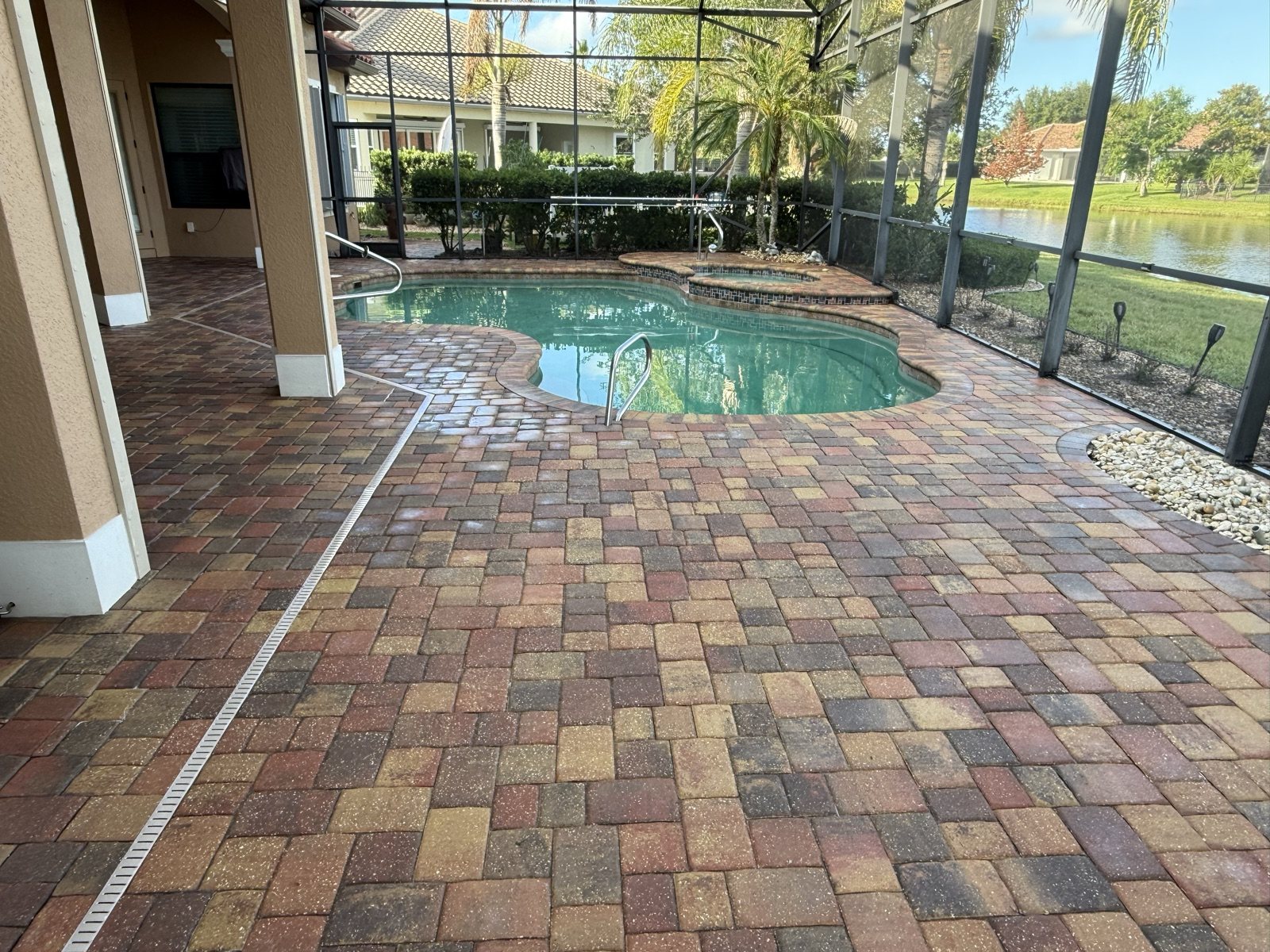
They come in more shapes, sizes and colors than any other material on this page, and they generally cost less than natural stone. Concrete pavers are pressed from a stiff concrete mix in molds at a plant, with the color mixed in. Once they're laid tight on a compacted base and the joints are filled with sand, they lock together and spread a load across the surface, which is why they work under cars. Don't confuse them with a poured slab, though. Our pavers vs. concrete guide covers that difference.
Not every concrete paver belongs on a driveway. Pavers come in more than one thickness, and the thicker units are the ones made to take tires turning on them every day. Thin patio stones and step stones are made for feet. Shape matters too. Smaller, squarer units laid in herringbone hold up to cars better than long planks or big slabs, which look great on a patio and aren't all rated for vehicles. The spec sheet for any paver line should say what traffic it's made for, and a driveway bid should name the thickness.
Is travertine a good choice around a Florida pool?
Often, yes, and that's why it ends up around so many Brevard pools. Travertine is natural stone, a type of limestone that forms where mineral springs leave calcium carbonate behind, and it tends to stay cooler under bare feet than concrete pavers. Outdoor travertine is usually sold with a tumbled or textured face that gives wet feet something to grip. The small pits and holes in the stone are part of the look, though some pavers come with them filled.
Travertine is porous, so unsealed stone soaks up rust, leaf tannin and sunscreen, and it needs a sealer made for natural stone. It's softer than concrete pavers, so edges can chip. Acid etches it, which means acid-based cleaners made for concrete and the muriatic acid used to balance pool water have to stay off the stone. It also generally costs more than concrete pavers. Our travertine pavers page goes deeper.
Are brick pavers the same thing as concrete pavers?
No, though plenty of people use the two names for the same thing. A true brick paver is fired clay, baked in a kiln, and its color comes mostly from the clay and the firing rather than an added pigment. That's why clay pavers have a reputation for holding their color in strong sun. A lot of what gets called "brick pavers" in Florida is actually concrete pavers shaped like brick, so ask which one a quote means.
Clay brick is hard and dense. It also comes in fewer shapes and sizes than concrete, mostly rectangles in earthy tones, and it can chip or crack when a corner takes a hard hit. It's harder to cut cleanly and less common here than concrete pavers. If you go with clay, buy paving brick and not wall brick. Paving brick is made to its own standard (ASTM C902 covers pedestrian and light traffic paving brick), and wall brick isn't made to be walked and driven on.
Do porcelain pavers make sense outdoors in Florida?
They can, on patios and pool areas where you want a clean, modern look. Porcelain is fired ceramic, so dense that it absorbs very little water. It resists stains and usually doesn't need sealing. Outdoor porcelain pavers are typically thin, large slabs, often made to look like wood or stone, and the color holds up well in the sun.
A smooth porcelain face can be slick when it's wet, so around a pool you want a paver sold for outdoor use with a textured, slip-resistant surface, not indoor tile. Thin slabs need a very flat, well-compacted base, and porcelain set on sand or gravel is generally for foot traffic only. On a driveway, most porcelain has to be set on a concrete slab, and only if the maker rates it for cars. It's also hard to cut, and dark colors still get hot in direct sun.
How do Florida conditions change which paver you pick?
Start with heat. Dark pavers in full sun get hot enough to matter on a pool deck, whatever they're made of, so color is the first lever and lighter tones stay cooler. Sun also fades the surface color of concrete pavers over the years, and sealer slows that down. Near the beach, from Cape Canaveral down through Satellite Beach to Melbourne Beach, salt air lands on everything. Porous stone takes it in, so beachside travertine especially needs to stay sealed, and a freshwater rinse now and then helps any surface.
Pool water lands on the deck with every splash, so a pool deck needs grip and a pitch that sends water away from the shell. A lot of Brevard sits on sandy soil that shifts and washes out when water runs through it, which is why what's under the paver decides more than the paver does. Then there's summer rain. Afternoon storms wash out joint sand and find every low spot, and polymeric joint sand needs a dry window to set. Freeze-thaw damage, the thing northern paver guides worry about most, is rarely an issue here.
Should you buy pavers and lay them yourself, or hire it out?
Buying pavers is the easy part. Home improvement stores stock common concrete pavers and patio stones, and landscape supply yards and masonry and stone suppliers usually carry more lines and thicknesses by the pallet, travertine included. Buy everything for one job at once so it comes from the same production run, pull from several pallets as you lay to blend the color, and keep a few spares for repairs later. Then add the rest of the system to the list: base rock, bedding sand, joint sand, edge restraint and rented compaction and cutting tools.
Laying them is the real job. You dig to a depth set by the use and the soil, compact the soil, then put the base rock down in compacted lifts with a plate compactor. The sand bed on top is thin and screeded even, and it's never used to fix low spots. Edge restraint gets fastened into the base, and joint sand gets swept in and compacted. A small walkway or patio is a fair DIY project for someone careful. A driveway, with tear-out, haul-off and cars on it every day, is where a base mistake turns into ruts in the wheel tracks. If you'd rather hand it off, we install pavers across Brevard County.
Free estimate
Rather just ask us?
Two minutes on the phone usually settles it — or send a photo of the space.
Related questions
What people ask next.
Can you lay pavers directly on dirt?
Not if you want them to stay flat. Bare soil, even Brevard's sandy soil, shifts, washes out in heavy rain and settles unevenly under weight, so pavers set straight on it start rocking and dipping. A paver surface that lasts sits on compacted soil, a compacted rock base and a thin sand bed, with edge restraint holding it in. Stepping stones in a garden bed are the exception, because nobody expects those to stay perfectly level.
What are the downsides of pavers?
They take more upkeep than a plain slab. Joint sand washes thin and needs topping off, weeds and ants can move into open joints, and if you want the color to hold, sealing comes around every few years. New concrete pavers can show efflorescence, a white haze that fades with time and cleaning. A paver surface is also only as good as its base, so a rushed install settles. The upside is that a section can be lifted and reset instead of patched.
Where's the cheapest place to buy pavers?
It depends on the size of the job, because the price of the paver is only part of what you pay. For a small patio, a home improvement store can work out fine. For a bigger job, supply yards that sell by the pallet are worth a call. Before you compare, add delivery, any pallet deposit, base rock, sand, edge restraint and tool rental, and order extra for cuts and breakage. Then check that the paver is rated for the traffic it will get.
What's the cheapest paver for a patio?
Standard concrete pavers usually cost the least of the four types on this page, and they come in the widest range of shapes and colors. Travertine, clay brick and porcelain tend to cost more for the same area. The paver is only part of a patio's cost, though. Base work, access to the back yard, the pattern and the number of cuts all move the total. Our cost guide walks through each one.
Keep reading
Where to go from here.
Fastest answer
Instant quote — give us a call.
Most questions we can answer on the phone in two minutes, and if we need to see it we'll book the walkthrough while you're on the line.
(321) 586-9227Or text a photo of the space — that's often the fastest way to get a real answer. Prefer email? [email protected].
Free estimate
Get a written number instead.
Free walkthrough, itemized estimate, no pressure.
Five quick questions — then you're booked in and someone reaches out within 5 minutes. Prefer to talk? Call (321) 586-9227.